Hyperopia
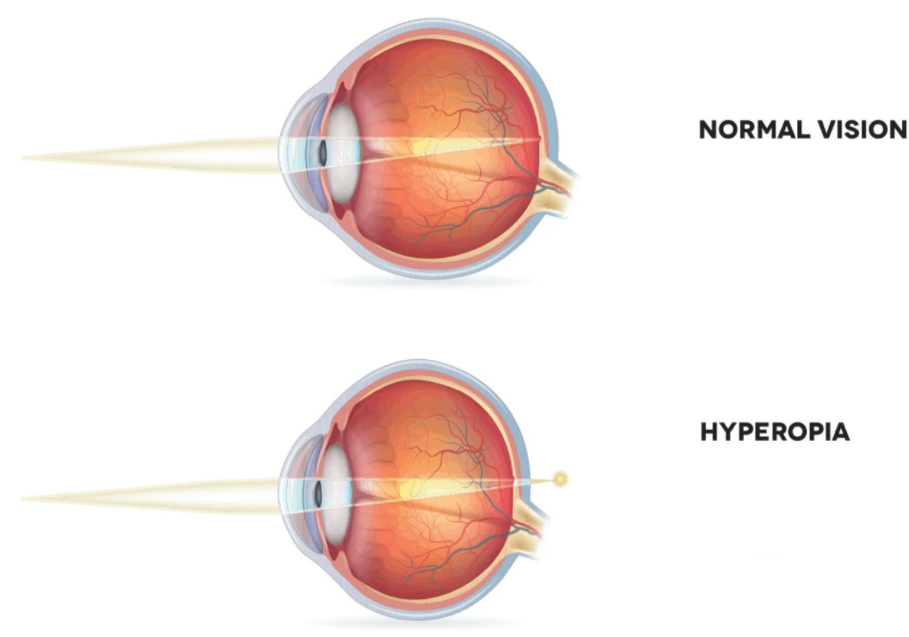
Hyperopia is a common refractive problem in which you can clearly see distant objects, but nearby objects may be blurred.
The degree of your visual acuity affects your ability to focus. People with severe hyperopia may only be able to clearly see objects that are at a great distance, while people with mild hyperopia may be able to clearly see objects that are closer.
Hyperopia is usually present at birth and tends to occur in families. You can easily correct this situation with eyeglasses or contact lenses. Another treatment option is surgery.
Symptoms
Hyperopia can manifest as follows:
- Near item appear blurry
- Needing to squint to see clearly
- You have eye strain, including burning eyes and pain in or around the eyes
- You have general eye discomfort or headache after doing close tasks, such as reading, writing, computer work or drawing, for some time
When to see a doctor
Make an appointment with an eye doctor if your child shows signs of vision problems or if a teacher mentions possible problems.
Make an appointment for yourself if you notice a change in your vision, if you have difficulty performing tasks such as driving, or if you find that the quality of your vision reduces the comfort of carrying out your activities.
Regular eye exams
Both children and adults may not notice vision problems or changes that occur gradually.
Children and adolescents
The pediatrician will perform relatively simple tests to check the health of your child's eyes at birth, between 6 and 12 months, and between 12 and 36 months. A more thorough check can be performed by the ophthalmologist if necessary.
A regular examination can be performed, it is useful to have it performed by the ophthalmologist.
Recommended eye exams should take place
- At least once between the ages of 3 and 5
- Before kindergarten, between the age of 5 and 6
- Every year until the end of middle school
Adults
The American Academy of Ophthalmology recommends that healthy adults with no known vision problems or eye disease undergo a complete eye examination according to the following schedule:
- At least once between the ages of 20 and 29
- At least twice between the ages of 30 and 39
- Every 2 to 4 years from 40 to 54 years old
- Every one to three years between the ages of 55 and 64
- Every 1 to 2 years after the age of 65
If you have diabetes, a family history of eye disease, high blood pressure, or other risks of heart or vascular disease, you'll likely need more regular eye exams. You'll also likely need more regular checkups if you already have prescription glasses or contact lenses, or if you've had surgery to correct vision.
Causes
Your eyes have two components that focus images
- The cornea is the clear dome shaped front surface of the eye
- The lens is a clear structure behind the iris
To be able to see, light must pass through the cornea and lens. They refract light so that light is focused directly on the retina at the back of your eye. This translates light into signals sent to the brain, which allow you to perceive images.
Refractive error
If your cornea or lens is not evenly and smoothly curved, light rays are not refracted properly and you have a refractive error.
Hyperopia occurs when your eyeball is smaller than normal or your cornea is less curved. The result is the opposite of myopia.
Complications
Hyperopia can be associated with various problems, such as:
- Strabismus. Some children with hyperopia may develop strabismus. Specially designed eyeglasses that partially or totally correct hyperopia may address this problem.
- Reduced quality of life. With uncorrected farsightedness, you may not be able to perform a task as well as you want.
- Eye strain. Uncorrected hyperopia can cause you to squint or strain your eyes to maintain focus. This can lead to eye fatigue and headaches.
- Reduced security. Your own safety and the safety of others can be compromised if you have an uncorrected vision problem. This can be especially serious if you drive a car or operate heavy equipment.
For hyperopia correction surgery click here

Personalized Servises for your Eyesight