Presbyopia correction
Presbyopia describes the inability of the crystalline lens of the eye to adjust its power to focus at close range. It usually begins to manifest itself from the age of 40 but can cause symptoms earlier or later.
Management options
The most common way to correct presbyopia is with the use of corrective lenses. There are many options for correcting presbyopia depending on the refractive error at far distance.
Presbyopia correction procedures are basically divided into 2 categories:
- in surgeries performed on the cornea
- in surgeries performed on the cornea
As for the cornea, the most common method is laser correction using the monovision technique. This involves correcting one eye for distance vision and the other eye for near/intermediate vision. Intermediate vision is usually preferred as, on the one hand, it allows better cooperation between the two eyes and, on the other hand, most activities (using a computer, laptop, mobile phone) correspond to the intermediate distance (60-70cm). This means that in some cases the patient will need a small correction to distinguish details at a closer distance.
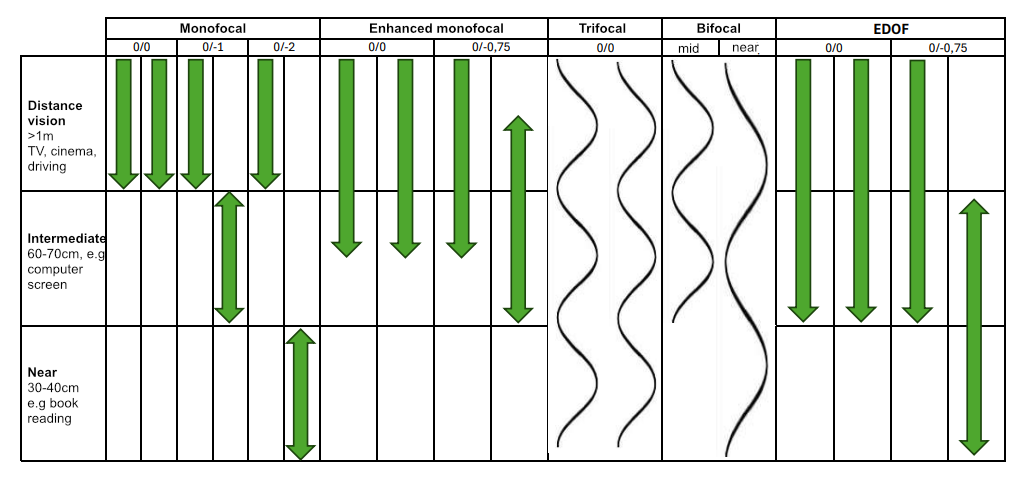
When we refer to operations on the lens of the eye, we usually refer to its replacement with an artificial intraocular lens with an operation similar to cataract removal. This technique is referred to as clear lens extraction (CLE). In this case, there are three main intraocular lens options:
- The use of a monofocal intraocular lens with correction of one eye for distance and one degree for intermediate/near vision (monovision)
- The use of a monofocal intraocular lens with correction of one eye for distance and one degree for intermediate/near vision (monovision)
- The use of a multifocal (enhanced depth of focus/ EDOF) intraocular lens in both eyes. In this case, excellent distance and intermediate vision and good near vision are provided.
- Variants or combinations of the above lenses are also mentioned.
There is also the possibility in young patients without clouding of the lens of the eye of the insertion of floating permanent lenses (implantable collamer lens/ICL) without removing the crystalline lens of the eye. In this case, it is possible to use either monovision or multifocal intraocular lenses.
From the above, it becomes apparent that although restoring the natural ability of the eye's lens to change focus depending on distance is not possible, there are a multitude of options that allow the presbyopic patient to be freed to some extent from the use of corrective glasses. It is obvious that a detailed examination by an ophthalmologist specialized in refractive surgery and a discussion of the options with the patient ensure the best possible result and patient satisfaction.


Personalized Servises for your Eyesight